
Inland and coastal shipping has tremendous opportunity to grow and support North America’s ambitions to deliver both economic and environmental progress. Ships are the most fuel-efficient way to move goods with the least amount of carbon emissions.
Ports, terminals, the St. Lawrence Seaway and shipowners are working to further reduce the industry’s environmental footprint by investing billions of dollars in new ships and technologies and participating in improvement programs like Green Marine.
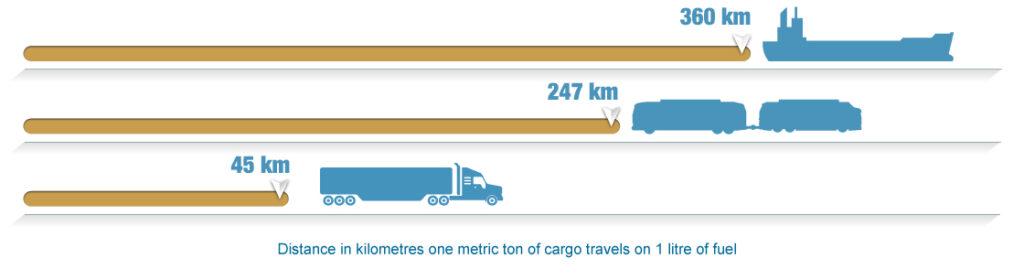
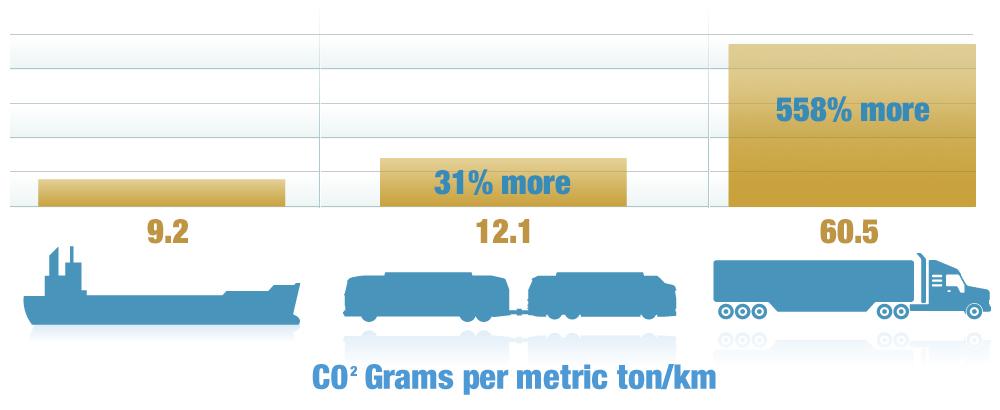
Due to its unprecedented investment in fleet renewal, CMC’s Canadian-flag fleet, on average, can carry one tonne of cargo an incredible 360 kilometres on one litre of fuel. Recent analysis by Research and Traffic Group also shows that due to that fuel efficiency, if rail and truck were to carry the same cargo over the same distance as CMC’s fleet, there would be 31 per cent more GHG emissions from rail and 558 per cent more from trucking.
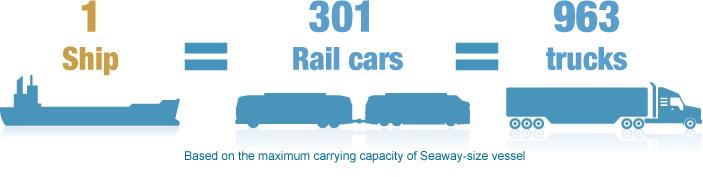
Ships are able to carry vast amounts of cargo in a single trip. Due to this carrying capacity, ships reduce road congestion and highway maintenance costs. It would take 7.1 million truck trips to carry the same amount of cargo that the Great Lakes-Seaway fleet does each year. That would increase existing truck traffic in the range of 35% to 100%, depending on the highway network. If Great Lakes-Seaway marine cargo shifted to trucks, it would lead to $4.6 billion in highway maintenance costs over 60 years.
In recent years, more than $4 billion has been spent to refurbish and build new domestic and ocean-going vessels for the region that have the latest engine technology and hull designs to increase fuel efficiency and decrease air emissions; double hulls to prevent spills in the event of an accident, and state-of-the-art cargo handling systems to minimize dust and cargo residue.
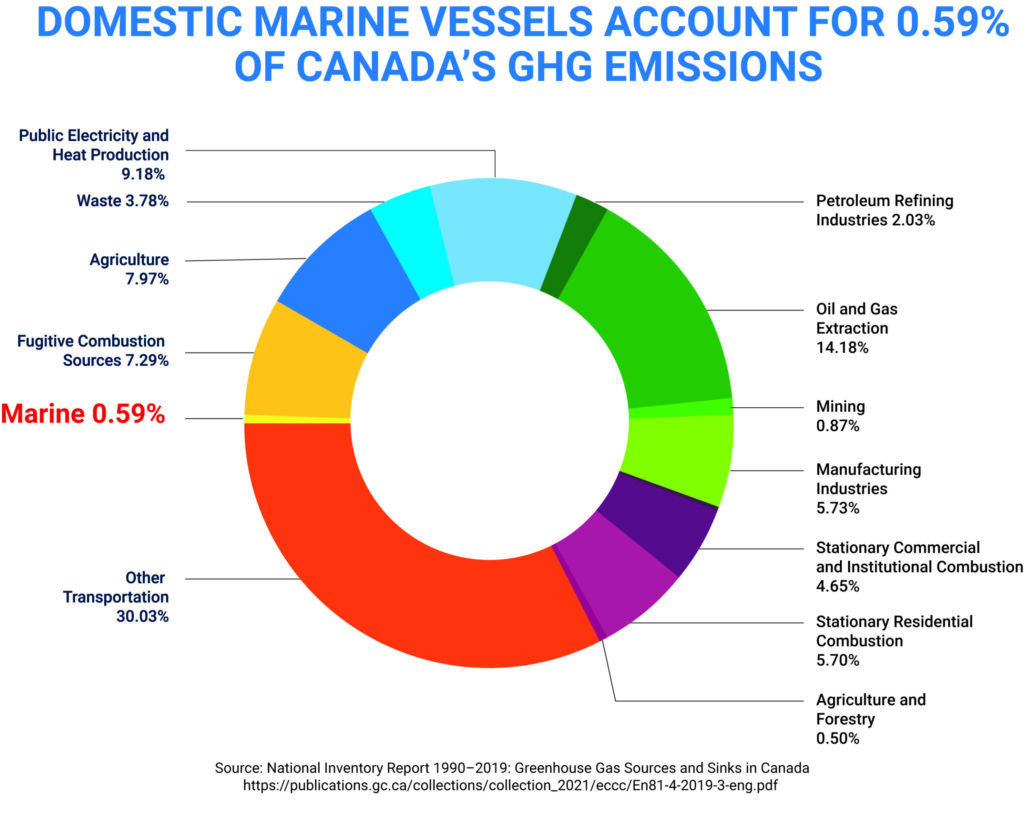
In Canada, the latest federal emissions inventory published in 2021, using 2019 data, indicates that the Canadian domestic navigation sector accounts for only 0.59 per cent of Canada’s national CO2emissions. The domestic navigation sector, as defined in the inventory, includes fishing vessels, ferries, Canadian Coast Guard and military vessels as well as cargo carriers.
CMC Members’ Fleet, which includes bulk carriers, tankers and articulated tug-barges, accounted for 19% of that the domestic navigation sector’s emissions in 2017.
Through its collective efforts, CMC ship operators have reduced their total carbon emissions by 183,000 tonnes or 19% between 2008 and 2017 (the latest year in which data is available).
Our ship operators are committed to reducing their carbon footprint further and have been taking various measures including:
The United Nations agency that regulates global rules for safe shipping and marine environmental protection, the International Maritime Organization (IMO), has committed to reduce 50% of shipping’s GHG emissions by 2050 compared to 2008 in absolute terms. This means no matter how much the world economy expands and trade increases, marine shipping’s total GHG output in 2050 must be half of its total output from 2008.
Nationally, Canada’s goal is to reduce 30% of all its GHG emissions by 2030 from 2005 levels, with work underway on further reductions beyond this goal.
Reaching longer-term GHG reduction goals will require significant global investment in research and development and deployment of new zero-carbon technologies and propulsion systems, such as green hydrogen and ammonia, fuel cells, batteries and synthetic fuels produced from renewable energy sources. With these needs in mind, the Chamber supports the global shipping industry’s proposal for IMO to create an International Marine Research Fund, that the industry will pay into and that is expected to provide some $5 billion to support research and development for these technologies.
The Chamber will continue to work with the international shipping community and the Canadian government to advance solutions that will be effective for the industry to meet the wider goals Canadians expect.

Marine shipping goes beyond its regulatory obligations to voluntarily improve all aspects of its footprint through the Green Marine environmental certification program. Ports, terminals, shipowners, Seaway corporations and shipyards undertake concrete and measurable actions to address 15 key environmental issues ranging from air emissions, waste management and ballast water to mammal protection and noise pollution. To receive their certification, participants must benchmark their annual environmental performance through the program’s exhaustive self-evaluation guides, have their results verified by an accredited external verifier and agree to publication of their individual results. Find out more >
The marine industry is committed to reducing, and eventually eliminating, the role it plays in the movement of aquatic nuisance species. Today, the Great Lakes – St. Lawrence Seaway System has the most stringent ballast water management and inspection regulations in the world. Since measures were introduced in 2006, no new aquatic nuisance species have been discovered in the Great Lakes due to shipping. International regulations since 2019 require the installation of ballast water treatment technology aboard all ocean-going vessels by September 8, 2024. Canada’s Ballast Water Regulations require this for domestic vessels built from 2009 onwards to meet this date, domestic vessels build before 2009 have until September 8, 2030.